Lessons from LibertyCon

I spent this past weekend at LibertyCon, which is billed as “A Tennessee Literary Science Fiction & Fantasy Convention”. That’s kind of like describing the ocean as “a bit damp”, for the record. It’s the literary SF convention in the US, attracting hundreds of authors, editors, publishers, artists, and other professionals in the business of writing entertaining stories.
I’ve wanted to attend LC for a while now. Originally, it was because I was a fan, and the author guest list significantly mirrors the names on my bookshelves. In the past couple of years, though, I somehow managed to sidle out of the “fan” category and into the “author” category.
I’m not quite sure how that happened.
I mean, I know how it happened. I started writing. I got a few things published. Which makes me an author, right?

I suppose it does, despite how I might feel about it. So attending LC this year, I figured I should listen to some people who had been there and done that.
I learned a lot. Story, plot, pacing, editing, marketing, sales - you name it, and if it was related to publishing, someone talked about it. Either in a panel, at an author’s table, or in a small impromptu conversation in the hall between sessions.
I came out with three basic ideas on how to make my writing more than a hobby.
Let's start with a reminder of the first really practical bit of advice. This is one that helped me get rolling a few years back. Larry Correia said, "You need to set a schedule, put your butt in the seat, hands on the keyboard, and friggin’ TYPE STUFF."
In one of the panels, D. J. Butler mentioned, "You need to have a bias for writing." I heard pretty much every other author echo that as well - different words, same idea. Git 'er done.
That's nothing new. Heinlein's first rule of writing is, "You must write." He shows us the core necessity. Butler reminds us to focus on the act of writing, not the accouterments. Larry emphasizes the (deceptive!) simplicity of the act itself.
Butt in seat, writing. When I made that happen, I wrote regularly and I learned to write better. I need to reestablish that daily writing habit.
Back to Heinlein. His second rule of writing is, "You must finish what you start." To me, that means learning how to do the really hard part of writing - going back and looking at my own work with a critical eye.
The scene I skipped because I didn't understand how to transition? Figure out how to fix that. The conversation that wandered and killed momentum because it doesn't advance the plot? Study how to make it work. The character that's not developing or the one that's really interesting but just doesn't work? Learn how to spot that and understand what I need to add or cut.
That means taking time to review my own work and clean it up so I can produce a final product. I need to establish a daily editing habit so that I finish what I start.
Finally? I need to read more. It doesn't have to be fiction, but it has to be something. Every author I talked to liked to talk about two things: what they were reading and what they were writing. The best ones seem to read the most. History, science, fiction, research, fantasy, romance, technical papers... whatever. You feed your body daily; why would you starve your mind?
From my own experience, I know that reading is a way to fill the tank, stir up ideas, and provide fodder for inspiration to gnaw on. Plus if I read about writing, I can learn how to create and edit better - a win-win! So I want to reestablish a daily reading habit as well.
So, here's my plan for the next six months.
Write daily.
Edit daily.
Read daily.
Ideally, I would like to do all three every day. I'd be happy if I can get at least two of the three done. I have my wife and a few friends who are willing to provide accountability.
For today?
I've written a bit about my experiences at LibertyCon. OK, yes, it's not fiction, but I didn't say I would only write fiction!
I had the time to think about a partially finished short story ("Terms of Employment") and jot down a page of notes on revisions I can make to improve the flow.
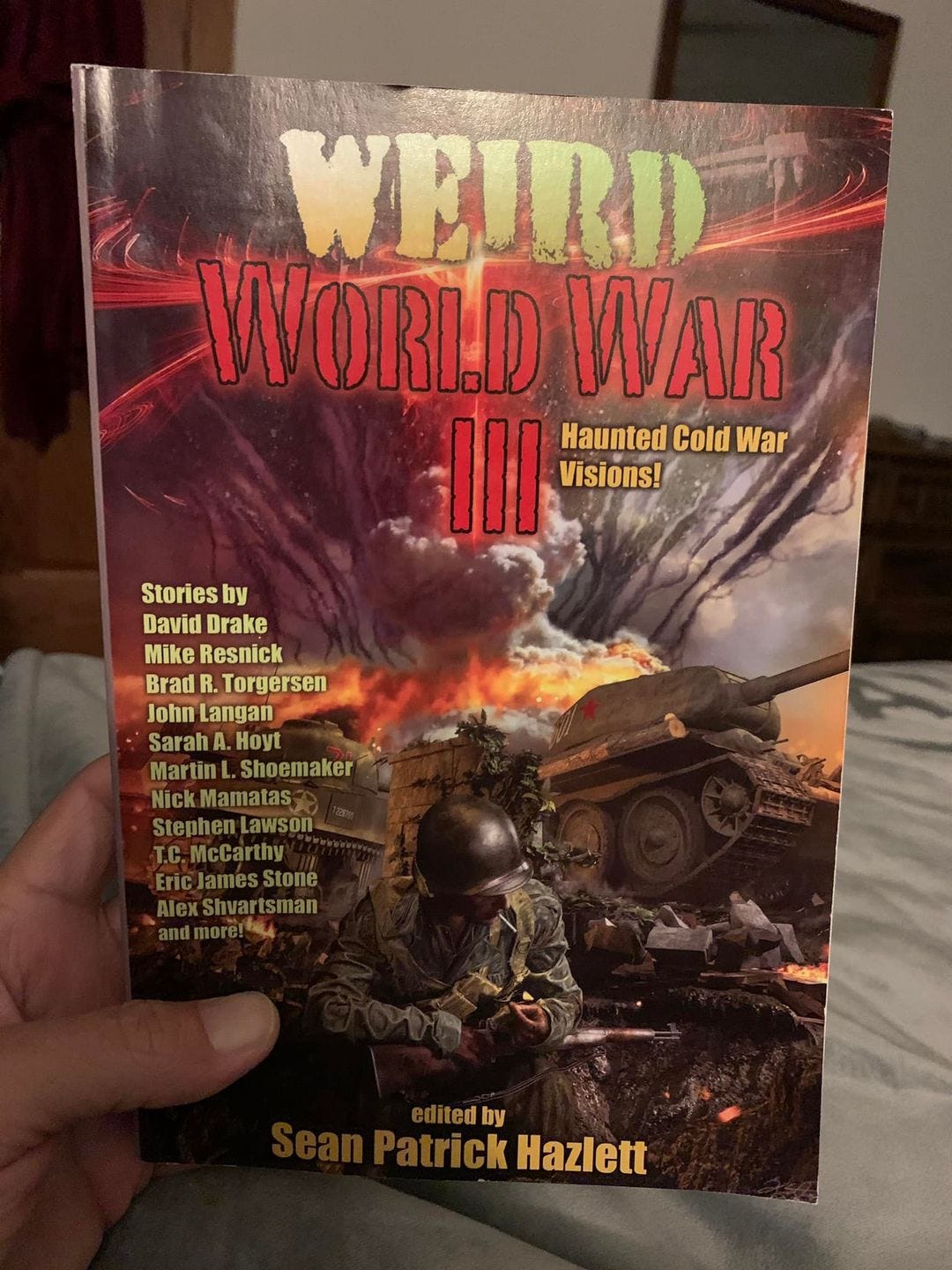
I've got a stack of books from this weekend, so I have no excuse not to dig into the Perpetual Pile on my nightstand. So I'm going to log off for the evening and settle down to read some stories from "Weird World War III" before I turn off the lights.
It's not the "one simple trick" that Teh Interwebs ads like to blather on about. It is three simple things I can do to improve myself as a writer, though. If I stick to it.
Now I just need to make it so.