Sides, Sides, Everywhere Sides!
Blocking out cooperation, breaking my mind...

Earlier this week, on Twitter, someone asked, “What do you think the greatest problem facing America is today?”
My response? “Us vs. Them.”
It doesn’t matter how you slice that, either. It could be left vs. right. rich vs. poor. Young vs. old. Rural vs. urban. Black vs. white. College vs. career. The real issue isn’t where you draw any particular line - it’s what we are doing after we draw those lines.
We need lines. They quite literally define sides. That’s their purpose. Lines break up the world into segments and help us organize our thinking.
A lot of times, that’s very useful. I am quite happy with a dividing line that says “these people here are not surgeons” and “these people here are surgeons”, for example. That’s a good practical dividing line. When I had my gall bladder removed on New Year’s Eve 2020, I was grateful that I could say it was being done by someone on the right side of the “surgeon/non-surgeon” line.
There are lines like that everywhere. So what’s the big deal all of a sudden?
It comes up when we stop thinking of lines as something that identifies distinctions and instead start thinking of them as something that defines opposition.
Social media exacerbates the issue. It lets us interact - almost forces us to interact - in terms of positive and negative. Likes and dislikes. Support or opposition. Smash that button to show where you stand then move on to the next post.
There’s little to no room for nuance… and in the past year, many people have been forced to interact primarily online and through social media. This is a huge problem because as I’ve said, social media is broken. Instead of interacting with other people, we’ve been shifted into interacting with the avatars for ideas. With someone who isn’t a person, but as nothing more than the embodiment of an idea we oppose.
So is it really any wonder we’re more divided now than ever?
Previously, I said that I don’t have a solution to fixing social media. I still don’t. It seems to be geared towards generating division. Whether that’s explicit or accidental, it seems like it’s here to stay.
There is a solution towards bridging divides, though. Something that will help us leave the realm of division and opposition, and return us to the much more useful idea of distinctions. Unfortunately - it’s not easy, and never has been. It’s particularly problematic right now, in fact. One of the major “Us vs. Them” arguments that everyone is picking sides for revolves around it.
If you really want unity? Get back to speaking to people face to face.
I’m not talking about Zoom or Jitsi or Teams or whatever online conference call software you’ve mastered in the last year, either. That’s a close approximation, but still only an approximation.
In the past year, I’ve had some amazingly caustic discussions online over particularly contentious topics. I’m a socially conservative Libertarian… I’ll let you imagine what kind of online interactions that can bring up.
Meanwhile, while all that was going on, I was also travelling and campaigning. Which meant meeting people face to face, and - inevitably - discussing those same topics.
I can honestly say that in a couple of months, over many states, I can only recall one instance where someone was even mildly antagonistic in person. This was even while discussing very sensitive issues. That’s not because the issues are suddenly less contentious. It’s not because the argument is suddenly different.
I believe that it’s because, speaking face to face, we were able to communicate in the way that we are optimized to communicate. There are rapid information flows and feedback adjustments that occur in-person that have incredibly significant effects on how we communicate with one another. When we pay attention to them - as we are built to do - then we start reacting to other people as people, not as avatars for ideas.
We see when someone is agitated and can moderate our own tone. They can see when we are being sincere and respond in kind. Taken all together, we go from having an argument to having a discussion. From trying to win a competition to trying to understand and solve a problem.
Online, we miss almost all those cues. Everything just takes too long. We stop thinking of people as people because they’re not there in front of us. We can’t see them, so the part of our mind that deals with those feedback loops has nothing to go off of except what we are feeling: annoyance, irritation, anger. Fight or flight!
Social media in a nutshell.
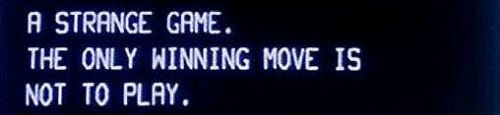
In the end, there’s really only one way to win the social media division game.